The Gap Is Widening: 2025 AI Recap and 10 Predictions for What's Next (Part 2)
2025 was an incredible year of AI progress. I wanted to take the time to map out the changes that mattered this year, summarise the key trends, and take a punt on where things might land for 2026.
This is part 2, to the previous post recapping 2025, where we speculate on 2026 and make some predictions.
I've also asked my vibe-coded LLM council to provide its predictions for 2026, which will be a bit of fun to track as we go into next year.
TL;DR
2026 predictions:
- Agentic workflows will be the dominant theme – coding agents first, then enterprise workflows
- The frontier gap will widen in 2026 – the chasm between those deploying agentic workflows and those still using AI as a chat app will widen. There is an information asymmetry in play - and new entrants and digital leaders will continue to up-end established markets
- Job displacement will become real and visible, particularly in knowledge work towards the end of the year
- Enterprise architecture and team structures will undergo fundamental rethinking
- The focus at AI frontier labs and AI companies will shift from models to products – models are good enough, products are not...yet
- Data centres will become the new strategic asset – the "new oil" for governments and major corporations
- Compute constraints will persist, but AI progress continues – memory and recursive learning primed to be the next step change in capability
- Government and public sentiment towards AI will start to turn from neutral to negative as impacts become tangible
- Frontier maths and science will emerge as the next capability jump
- Anthropic will likely IPO in H2 2026; OpenAI IPO announcement towards year-end for a 2027 date
Part 2: Predictions for 2026
Here are my key predictions and trends for 2026, ranked by strategic importance.
1. The Year of Agentic Workflows
If 2025 was the year of agents, 2026 will be the year of agentic workflows.
The chat interface is incredibly limited – most consumers don't know what to ask or how to push models to their limits. 2026 will see rapid advancement of workflows:
Coding workflows first:
Cursor's Agentic Dashboard is the first taste of a new way of coding for software developers. Engineers will manage a team of agents and supervise architectural and design decisions required for those agents to deliver outcomes. The days of handcrafting code will largely be over for commodity coding work – with hand-rolling code remaining the last bastion for niche codebases where models haven't been trained.
Enterprise workflows follow:
As we move into Q2 and Q3 2026, we'll see new solutions open up that mimic what the developer ecosystem has been working with – namely workflows for business use.
Creative cases around marketing, branding, and image/video creation across social and marketing channels will be the natural starting point (these patterns are largely individually solved today). Marketing may be one of the first workflows to be nearly fully automated – from idea generation, to content creation, to customer testing, to full ad rollout, to ROI measurement. Major low-hanging fruit across more commodity / high volume workflows.
We'll also see expansion to:
- Finance workflows
- Knowledge work workflows
- Contact centre workflows
- Business admin and management
Tool use, long-horizon work, and multi-agent orchestration are the new strategic lever – agents that work while you sleep. By year-end, I expect coding agents to work reliably for 24 hours in mainstream use, and multiple days in-house. For certain non-coding workflows, I expect us to be around where we are now on coding workflows - multi-hour use cases on certain items (with frontier companies pushing the boundaries), and an ability to allow a range of agents to trigger and execute autonomously on short-medium time horizon tasks across a range of sectors.
This long horizon capability will be a major step change; agents working in the background for hours on end, workflows that are AI-native, with humans in the loop when needed.
2. The Frontier Gap Widens
There's a growing chasm between those operating at the frontier of AI – software engineers, early adopters, and teams actively experimenting with agentic workflows – and the average user who primarily interacts with AI through ChatGPT or Claude app.
Most people are still using AI as a glorified search engine or document assistant. Meanwhile, frontier users are orchestrating teams of agents, running 24-hour coding sessions, and fundamentally reimagining how work gets done. This gap will likely continue to widen until the onset of compelling consumer / enterprise products that bring these capabilities to the mass market.
The risk for enterprises: if your teams are still at the "chat with an app" layer while competitors are deploying agentic workflows, you risk falling behind.
The right company response will depend on the specific industry and where AI creates leverage, and different responses will be required for highly competitive market places as opposed health / public sector / government.
For tech-native and digital-first companies – the upskilling imperative is urgent and hands-on:
- Exposure to agentic tools (Cursor, Claude Code, OpenAI Agent SDK)
- Understanding prompt engineering at depth, not just surface-level prompts
- Learning to supervise and orchestrate AI systems, not just query them
- Building internal capability to evaluate and adopt new workflows quickly, but with rigour around ROI
For non-digital-native enterprises – manufacturing, utilities, healthcare, government – the priorities are different but no less important:
- AI literacy at leadership level: understanding what's possible and where the real leverage points are
- Identifying 2-3 high-impact use cases specific to your domain
- Building procurement and governance capability to evaluate vendors and manage model risk
- Preparing for workforce transition as AI-enabled tools reshape roles
Every company will need to close the gap – the response may just look different. Those that don't will find their talent increasingly disconnected from what's actually possible.
3. Job Displacement Becomes Real
As enterprise workflows become apparent towards the end of 2026, we'll start to see job displacement and role re-design become a real trend.
It's not clear whether companies will keep staff and increase productivity expectations, or take productivity gains with fewer personnel. This will come down to the specific dynamics of each sector and company. What is clear though is that employees today will need to be very conscious about their role and rethinking their skills and capabilities for a rapidly changing knowledge work environment.
To be successful in this new world, many people will need deep curiosity, the ability to learn hard skills fast, and be broader and/or deeper in skills that are in demand
Example – Software Development:
Traditionally, we would design squads around the "two pizza" rule – a product owner, potentially a tech BA, a number of engineers (full-stack, front-end, back-end), maybe a data scientist/engineer, or regulatory/legal personnel.
Many roles in this typical squad design will change or converge over next year, for companies heavily adopting AI. If AI can build much of the designs, documents and code, do teams need a product owner and a front-end designer and a BA and a junior dev?
In Cursor today, an engineer can build not just code but design out a front-end design system and test it. In Figma, a UI/UX designer can design out a brand system and build out the required code, while also submitting PRs via an AI-enabled IDE or one of the new AI CLIs such as Claude Code or OpenAI Codex.
Of all the roles shifting in 2025, the software engineer looks set to change the most. Tools like Claude Code, Cursor, and Antigravity are enablers – but the real shift is in the process itself: engineers can now delegate to agents rather than writing code line by line, for increasing aspects of their work. The fundamental change that is occurring is in how software gets built. If this pattern accelerates in 2026 as expected, the implications for team structures, hiring profiles, and what it means to be a "senior engineer" will be profound. My take is that there will be an insatiable demand for the '10x Coder'.
Role boundaries are blurring. When AI handles the implementation grunt work, the distinctions between traditionally separate roles start to collapse:
- Front-end engineer + UX designer → the ability for one person to perform design and build aspects of the solution
- Product Owner + Business Analyst → the ability for one to define strategy, scope, backlog, requirements and validate delivery
- Back-end Engineer + Data Engineer → the ability for one person who builds APIs and manages pipelines
At the same time, new specialisms are emerging that didn't exist two years ago: prompt engineers, AI workflow architects, model evaluation specialists, field forward engineers, and "AI-native" product managers who think in terms of agent orchestration rather than just feature backlogs.
The implication for organisations: smaller teams, broader roles, select partners, and a premium on people who can work across traditional boundaries.
4. Enterprise Design Gets a Rethink
Both the way we architect enterprise systems and the way we design teams to build/test/run those systems will go through a major rethink – happening in earnest as we get to end of 2026 as long-running coding agents and the new patterns of working with them become well understood.
Traditionally enterprises have relied on SaaS systems and the economics around renting technology. But with agents able to code quickly and reliably, the cost economics of the SaaS model for certain product types may come under question.
The last decade saw enterprises shift decisively from build to buy. But if agents can code reliably, does it now make sense to build again – particularly for workflows bespoke to your company or industry? Or will SaaS vendors find ways to marry their system-of-record strength with agentic automation? The answer will reshape how we think about enterprise architecture.
I expect the first AI-native SaaS product to emerge that completely reimagines the traditional stack – a bellwether for how traditional SaaS vendors will need to respond. This new paradigm requires blending the structure / rigour around how we generate, store, move and verify data, whilst allowing traditional and new agentic workflows to co-exist, with governance / risk management at the core.
Enterprise-specific shifts:
- Distilled model variants will be the major economic driver – bespoke agents fine-tuned for medico, banking, insurance, and other verticals
- Inference becomes a new dominant cost centre - enterprises will need to budget for AI like they budget for cloud. SaaS pricing will shift too – pure per-seat licensing won't suffice in a variable-inference world.
- Conversational search becomes the default interface – replacing traditional keyword search across enterprise systems. Voice to text will become the default input method, serving as an alternative to keyboard typing, for many - saving hours of typing per week.
- Governance and risk management moves up a capability level – model risk management, AI security, and audit trails become table stakes
- Cybersecurity, fraud, and phishing become major threat vectors requiring new AI-powered responses – the same tools that help defenders are available to attackers
5. The Focus Shift from Models to Products
Model intelligence will continue to grow, and we'll see new models optimised for different use cases. But for companies adopting AI or building AI-powered products, the focus needs to shift from the model to the product experience – leveraging what these models can already do to deliver real-world utility.
Models are already good enough. What they lack is an intuitive product experience to support mass adoption for everyday work. CustomGPTs, GEMs, Skills, are bridges between where we have been and where we are going. There are major opportunities to rethink the entire value chains. Loveable.dev's approach to website / product development is one example.
This places companies like Google and Microsoft with a unique advantage – they already sit on many of the tools people use every day: mail, calendar, scheduling, cloud infrastructure, creative tools, mapping, and enterprise documents. They're uniquely positioned to bring together model intelligence with workflow execution.
I think we'll see:
- Anthropic broaden their Claude Code branding to more enterprise use cases
- OpenAI lean more into its Agent SDK and build out full enterprise workflow capability
We'll also see a host of enterprises and startups building new experiences around these models that were not possible before.
6. Data Centres: The New Oil
Countries with access to both model labs and data centres will be best positioned for success. There will be no intelligence explosion without data centre prolifieration. People are worried that data centres are tied to a bubble scenario. From what I am seeing, the agentic coding developments this year alone, point to a dramatic increase in the demand for tokens from what we have today. That is before the plethora of R&D and inference tokens required to build and run models for the other model types / domains / applications.
This data centre expansion requires:
- Infrastructure planning by governments
- Appetite to draw investment and take risk
- Sovereign strategy around controls and fallbacks
Does a sovereign state want to be beholden to another sovereign state's data centres and models in the event of trade conflict or war?
The implications extend beyond economics into defence, security, and geopolitics. In 2026, countries will make defining choices: invest heavily to lead, partner for access, or accept strategic dependency on others.
7. Compute Constraints Persist, But Progress Continues
AI will remain dramatically compute-constrained until 2027, but with significant compute coming online, we won't see a slowdown in the pace of model development.
Expect:
- Further gains around pre-training – labs continue to squeeze more capability from existing data through better curation, curriculum learning, and synthetic data generation
- Continued RL (reinforcement learning) benefits – RL has proven particularly effective for reasoning tasks; models like o1 and o3 demonstrate that extended "thinking" at inference time, trained via RL, can unlock capabilities that pure pre-training misses. Expect this pattern to deepen: RL applied to tool use, multi-step planning, and self-correction, and across a wide variety of domains.
- Advanced memory improvements – both in-context (longer context windows, better retrieval) and persistent (cross-session memory, agent state) will enable AI systems to work on problems over days rather than minutes
- Potentially a breakthrough in recursive learning – where AI systems, likely first deployed in pre-training pipelines, will be able to supervise their own training runs, analyse what's going right and wrong, and provide recommendations – potentially executing some independently. If recursive learning matures, it could fundamentally change the trajectory: AI improving AI creates a compounding loop where intelligence gains accelerate
8. Public Sentiment Turns
As companies start to reconsider their team designs, some job displacement and redesign will occur. This will be a lightening rod for users, and in an inflationary / higher interest rate economy, public sentiment could turn and bring political change in how governments respond to AI.
On one hand: businesses will be pro-AI looking to drive growth and reduce costs.
On the other: Left-leaning parties will champion workers' rights and more regulation. Real human stories will start to emerge around displaced workers and the challenges with reskilling.
The real danger with AI is the speed at which adoption and it's twin, disruption, could occur.
ChatGPT was the fastest app in history to reach 100 million monthly active users – doing so in roughly two months after launch, compared to Instagram's 2.5 years.
While enterprises have sticky legacy systems, AI can still be adopted rapidly around the edge and between current systems. There's high risk of a rapid adoption cycle creating a messy transition for the economy as it transitions the workforce.
The key will be how we handle retraining and redistribution of workers. I worry that the educational system - from secondary school to third level plus worker training / certificates - is not set up yet to help people build the skills required for a world where recall / memory / basic document handling are not required. Higher-order thinking and using these tools to deliver results are new skills that we need to develop. Governments that act early on retraining and workforce policy will manage the transition best.
9. Frontier Maths and Science Emerge
I think we'll see frontier maths and science emerge next year as the next major capability jump. This will:
- Open new opportunities for science and medicine to accelerate work
- Democratise advanced modelling in mathematics: tasks that once required specialist ML teams become accessible to engineers and business analysts working with AI-native tools
10. The AI Bubble Question and IPOs
Certainly many will invest in AI companies that will be surplus to requirements or will fail. But fundamentally I predict:
- OpenAI, Google, Anthropic, xAI, and Meta will go from strength to strength
- Anthropic will likely have to IPO towards the end of 2026
- OpenAI will announce IPO intentions towards very end of 2026
These IPOs will be bellwether moments – setting clear data around revenue and cost trajectories and the economics required to scale intelligence further.
The R&D pathway at announcement time will be important: how much model intelligence growth will there really be post-IPO? Particularly regarding data availability and the potential for two more key training runs with available data.
Discovering AI that could in a sense improve itself would clearly be a bellwether moment that would open up unprecedented economic growth for those who achieve that milestone early.
The key risk to frontier lab valuations: timing. If data centre capacity slips or product bets don't convert to planned revenue, the path to IPO gets harder – especially for labs still burning cash on training.
For OpenAI specifically, the consumer story matters: can advertising revenue and 800 million weekly users translate into a durable business alongside enterprise and API growth?
Part 3: LLM Council Predictions for 2026
Earlier this year I vibe-coded an LLM Decision Council – a multi-model deliberation platform that runs prompts through specialised seats (strategy, risk, tech, finance, and more), forces structured peer review, and has a Chair model synthesise a final view. It's designed for high-stakes decisions where surfacing disagreement matters.
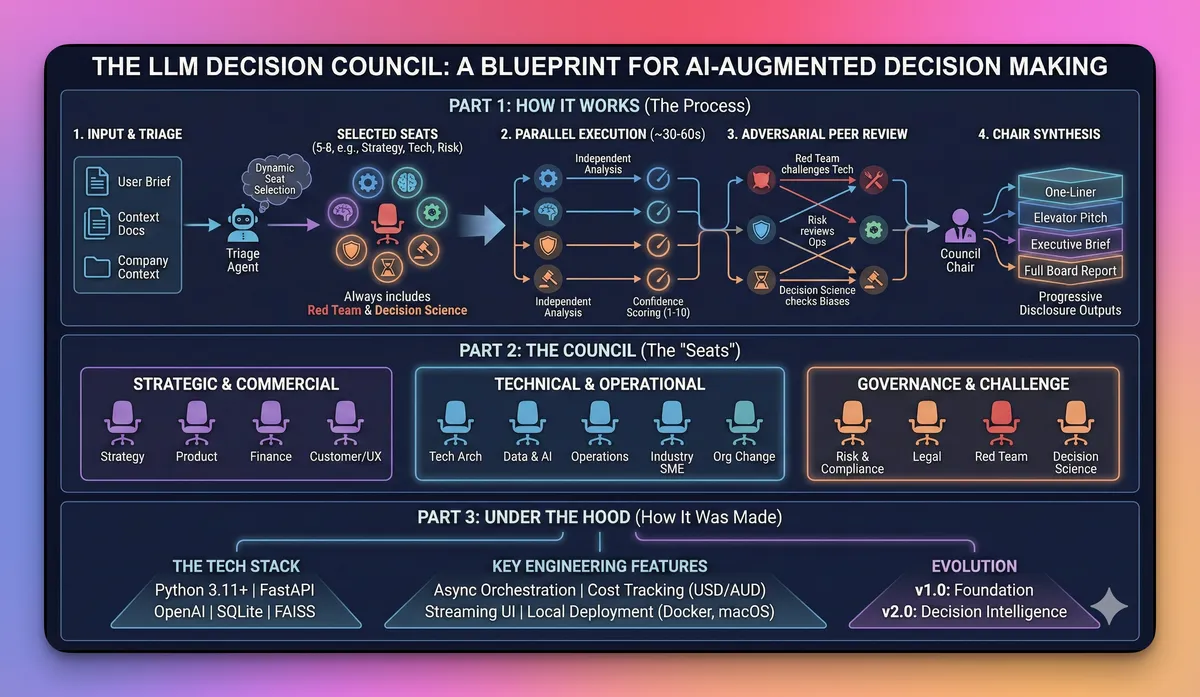
I asked the council to provide a comprehensive 2026 outlook. Here's how the process worked:
- Deep 2025 analysis: I asked the council to first conduct a thorough trend analysis of what occurred in 2025 – looking across foundation technology, frontier lab development, infrastructure, consumer apps, and enterprise adoption.
- Synthesis: The council synthesised the key trends from that analysis into a structured year-in-review.
- 2026 predictions: I then uploaded that synthesis and asked the council to predict the top trends for 2026 across three categories: enterprise (B2B), consumer (B2C), and frontier model labs.
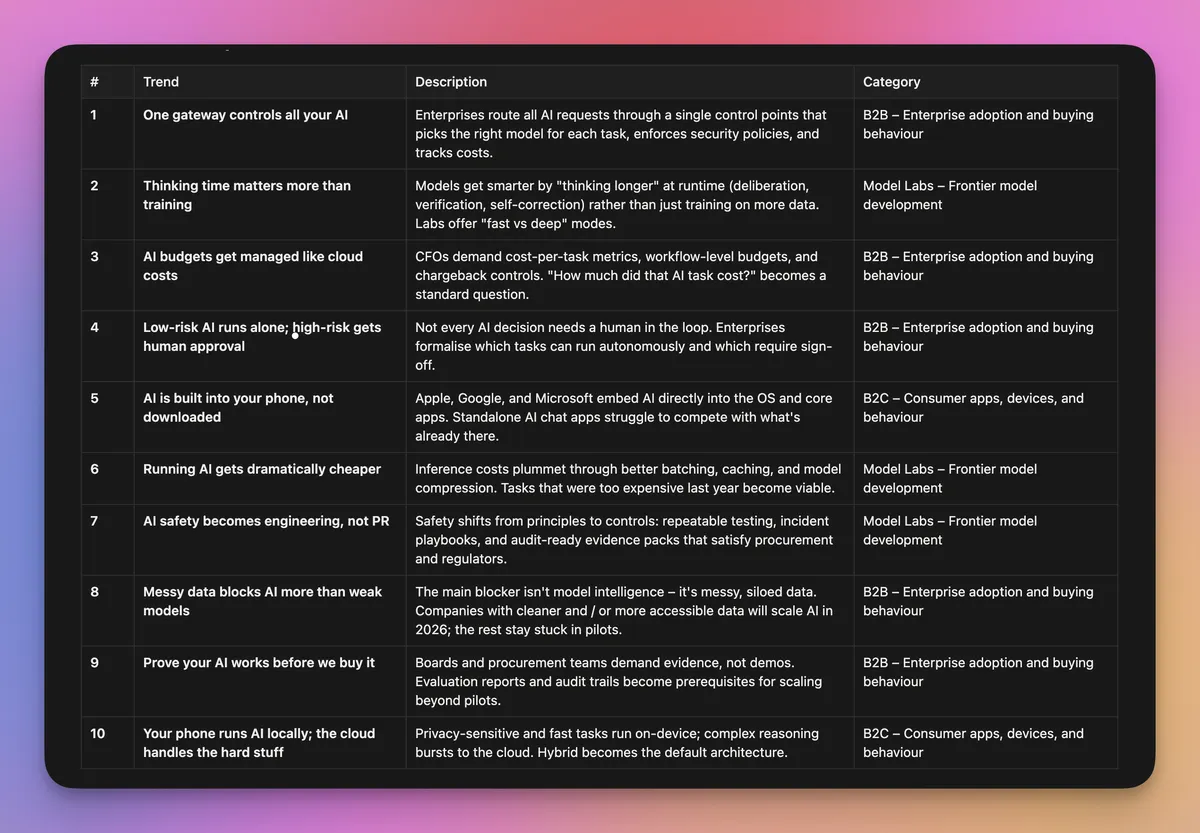
- Prioritisation: The council produced 30 trends in total across these categories. It then condensed these down to the 10 most material trends, ranked in order of strategic importance.
The council's overarching frame is: "The Industrialization of Agency" – moving beyond the pilot purgatory of 2025 into autonomous enterprise workflows and a definitive shift from training-centric to inference-centric economics.
The Council's Top 10 Predictions for 2026
Tracking the Predictions
So there you have it – my 10 predictions for 2026 and the council's top 10 predictions.
It'll be interesting over the course of this year to compare how my predictions stack up against the council's. We'll revisit both sets periodically and score who got it right – human intuition versus multi-model deliberation.
Closing thoughts
The gap between what 10x coders are doing today and what the average knowledge worker understands is vast – and widening. But that gap is also an invitation: the tools are more accessible than ever, and those who lean in now will help shape how work gets done for the next decade.
Every company is an AI company now. They may not just know it yet.
Sample Sources & References
2025 Developments
General
- [AI Resource Hub — Real-Time Leaderboards, Policies, Tools (2025)](
Frontier Models & Labs:
- Introducing GPT-5 – OpenAI(https://www.aussiebytes.com/ai-resource-hub-real-time-leaderboards-policies-tools-2025/)
- Claude Sonnet 4.5 – Anthropic
- Gemini 3 – Google DeepMind
- OpenAI launches two 'open' AI reasoning models – TechCrunch
Open Source & China:
- China's cheap, open AI model DeepSeek thrills scientists – Nature
- The Chinese finance whizz whose DeepSeek AI model stunned the world – Nature
- China's Moonshot AI Releases Trillion Parameter Model Kimi K2 – HPC Wire
- 'Another DeepSeek moment': Chinese AI model Kimi K2 stirs excitement – Nature
Compute & Infrastructure:
- NVIDIA hits $5 trillion valuation as AI boom powers meteoric rise – Reuters
- AI Developments That Reshaped 2025 (Project Stargate) – TIME
Data Constraints:
Scientific Breakthroughs:
- DeepMind and OpenAI models solve maths problems at level of top students – Nature
- AI Took on the Math Olympiad—But Mathematicians Aren't Impressed – Scientific American
- Gemini with Deep Think achieves gold medal standard at IMO – Google DeepMind
- Early experiments in accelerating science with GPT-5 – OpenAI
- WeatherNext 2: DeepMind's most advanced weather forecasting model – Google
- Supporting better tropical cyclone prediction with AI – Google DeepMind
- Genie 3: A new frontier for world models – Google DeepMind
Robotics & Multimodal:
- Gemini Robotics – Google DeepMind
- Gemini Robotics 1.5 brings AI agents into the physical world – DeepMind
Adoption & Enterprise:
- The 2025 AI Index Report – Stanford HAI
- State of AI 2025: Year in Review & Analysis – Lumenova
- The Year AI Went Fully Mainstream: A Complete 2025 Recap – Scalevise
Regulation & Policy: