The Constellation Model: A skills framework for people who work with AI
The career advice we have followed for decades was built for a world where humans were expected to execute the work. Here is a new perspective on building skills for the AI age.
In 1991, David Guest first described the T-shaped professional: deep expertise in one field, broad awareness across many. A decade later, IDEO CEO Tim Brown made it the centrepiece of his hiring philosophy, and it became gospel across industries. Go deep in one area, stay broadly aware across others, and you will thrive.
It was a useful model for a world where human capability was constrained mainly by time, attention, and hard-won implementation skill. A senior developer created value by writing excellent code. A designer by crafting polished interfaces. A strategist by building the deck, argument, and narrative that moved the room.
That model still has value — but it was built upon a bottleneck that is now shifting as AI commoditises large swathes of knowledge work. It is built upon the idea that division and specialisation of labour around single or just a few domains matters.
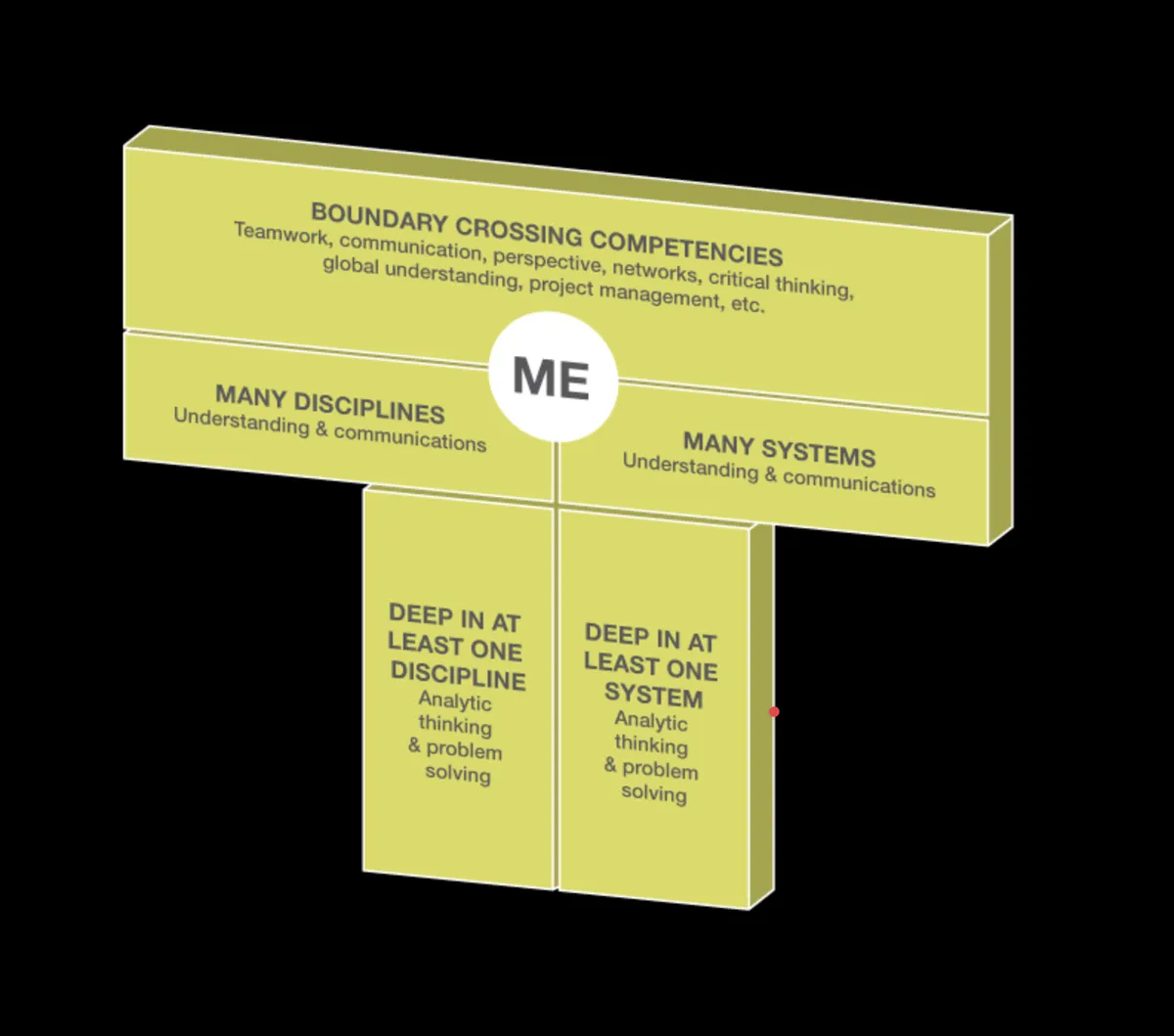
However, how is the concept of division and specialisation of labour impacted, in the knowledge-work world where those specialisations are being executed by AI? What are the new skills and capabilities people need?
As AI starts to take on ever greater components of tasks within and across job roles, the limiting factor is no longer whether the work can be produced at all. It is whether the right problem is being framed, the right trade-offs are being made, and the output is driving value and is being integrated into real systems, teams, and decisions.
This is the shift many people have not fully internalised. It also requires a new way of working.
The Shift AI Is Forcing in Role Design & Skills
In a January 30th X post this year reflecting on a Vercel fireside chat, Guillermo Rauch wrote about how people would need “…deep understanding of how systems and architecture fit together. The implementation and code-writing is the agent's job."[1]
The implementation is the agent's job.
The evidence is mounting. In early 2024, Klarna announced its AI assistant had handled 2.3 million customer service conversations in its first month — the equivalent output of 700 full-time agents. By Q3 2025, the company revised that figure to 853. But then Klarna started rehiring humans for the judgment, context, and relationship work AI couldn't replicate.
That reversal is telling. AI didn't simply replace people. Instead, where people would now play a role in the process.
The scarce resource is no longer the ability to execute. It is now the ability to know what's worth building, understand how systems connect, and judge what's actually working.
The World Economic Forum's Future of Jobs Report 2025 — surveying over 1,000 employers representing 14 million workers — reinforces this: employers expect 39% of core skills to change by 2030, with analytical thinking, curiosity, and lifelong learning rising fastest. The premium is now the ability to learn faster and to think across boundaries.
The classic T-shape skilled professional is not protected from this shift. Its deep vertical bar — your specialist skill — is precisely the part most exposed to automation. And its broad horizontal bar — general awareness — is too shallow on its own to generate differentiated insight and value for companies. This horizontal bar is also likely to be commoditised in part by AI, where managers and CEOs will soon have their own agents driving awareness and general management functions across the organisation.
We need a model that better reflects where value is moving.
Why the Old Shapes Start to Strain
The T-shape wasn't the end of the conversation. Pi-shaped (two deep skills), comb-shaped (multiple deep skills) — each evolution added more vertical bars.
Each of these improved on the original by adding more depth in more places. But every upgrade was built on the same assumption: people would still need to do the implementation themselves. They all relied on the same basic logic: stack more specialist pillars and place general awareness across the top.
The problem is not that these models are wrong. It is that they still describe value mainly through depth of execution.
In an AI-enabled environment, depth still matters, but it matters differently. The question is no longer only, “What can I personally produce end to end?” It is now "How do I frame, orchestrate, evaluate, and combine activities better than others to create value?”
That requires a different shape.
Introducing the Constellation Model
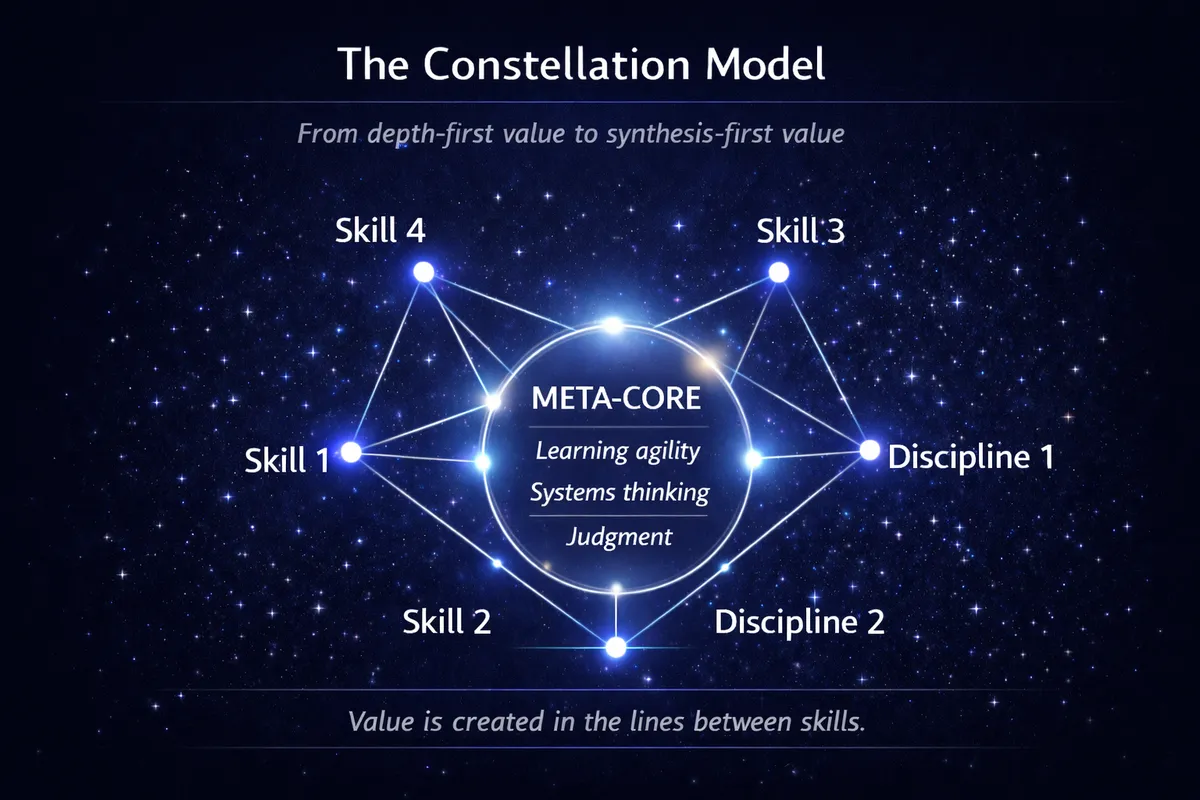
Instead of a letter, imagine a constellation.
A constellation has a few qualities that map well to work in the AI era:
- It is unique to you. No two constellations are identical. The value comes from your specific pattern.
- It is pattern-forming. Individual stars matter, but the shape emerges from the lines between them.
- It is navigational. A constellation helps you orient. It shows where you are strong and where you could go next.
- It evolves. The core pattern can hold while the visible points change over time.
This offers a better model for modern careers because it reflects something older frameworks understate: your advantage increasingly comes from synthesis.
The Core: Three Meta-Skills
At the centre of the constellation sits a tight cluster of three meta-skills. These are not tied to a single domain. They increase the value of every domain you touch.
1. Meta-Learning — Learning Fast and Learning Well
Older skills models treated breadth as a passive state: know a little about a lot.
That is no longer enough.
What matters now is active learning velocity: how quickly you can get from unfamiliarity to working fluency in a new area. In a world where tools, practices, and even whole sub-fields can change in months, the ability to learn quickly is a competitive advantage in its own right.
Meta-learning means knowing how you learn best, being able to break unfamiliar domains into components, building systems for capturing and revisiting knowledge, and reducing the time between “I do not understand this” and “I can think clearly about it.”
2. Systems Thinking — Seeing the Structure Beneath the Work
As AI compresses implementation, architecture becomes more important.
Systems thinking is the ability to see how components, incentives, dependencies, and constraints interact. It is the ability to zoom out without becoming vague.
This goes beyond technical architecture. It is about seeing the whole system (for example, across people, processes and technology in a company). It includes understanding how a product decision affects the business model, how a design choice affects engineering velocity, how a governance decision affects delivery speed, or how a market shift ripples through a value chain.
People with strong systems thinking do not just solve isolated problems. They understand the structure of the problem space. The think from first principles, and take action on good data that sees the system as a whole, not just in parts.
3. Judgment (or Taste) — Knowing What Good Looks Like
The third meta-skill is taste. You could also call it judgment.
This is the ability to distinguish strong from weak, signal from noise, promising from dangerous, and good enough from genuinely good. It matters because AI can now produce abundance on demand. More options is not the same as more clarity.
Taste is what makes a product leader say "something feels off about this flow" before they can explain why. It is what makes a strategist sense that a narrative is not landing before the data confirms it. It is what lets you spot a brittle architecture, a shallow strategy, a misleading metric, or an elegant-looking output that will fail under real conditions.
Taste is also connected to human value. Analysis and decision making, for many activities across knowledge work, will be managed over time by AI. But knowing what people want, what will bring people value, what will surprise / delight, adjudicating on the appetite for risks - these are likely to be human-led in a world of ever increasing AI-generated content.
AI can generate a hundred plausible options. Human value will increasingly be measured in the ability to choose well.
The Points: Two or Three Deep Disciplines
Radiating out from the core are two or three deep disciplines. These are your outer points: the domains where you have built, or are deliberately building genuine expertise.
A constellation point can be a discipline (behavioural psychology, economics), a practiced skill (software architecture, data modelling), or a deep domain (financial services, healthcare, energy). What matters is whether the point gives you a distinct lens: its own questions, its own evidence, its own mental models. Domain knowledge qualifies when it goes beyond surface familiarity into genuine structural understanding of how that world work. For example - its incentives, constraints, regulatory logic, and failure modes.
The key is not just depth. It is orthogonality.
Orthogonal disciplines are ones that don't naturally overlap. A developer who also has deep expertise in behavioural psychology. A designer with serious knowledge of financial modelling. A technologist with deep healthcare domain knowledge and design expertise. A marketer who genuinely understands systems architecture.
If your points are too close together, your constellation collapses into a line. You become more capable, but not necessarily more differentiated.
If your points are meaningfully different, the distance between them creates room for original insight.
A useful test is simple: do these disciplines ask different questions, use different evidence, and train different mental habits? If they do, they are more likely to generate valuable synthesis. This also means more diversity of thought and insight, in a market crowded with activity happening at ever increasing velocity.
A Concrete Example
Take a product leader whose constellation points are software delivery, behavioural psychology, commercial modelling, and experience (both failures / successes) in scaling products to market.
AI can help that person draft user stories, generate research summaries, sketch interfaces, model scenarios, and pressure-test feature ideas. But their real advantage is not in producing each artefact faster than everyone else.
It is in combining the disciplines, working with AI, to choose the paths to proceed on, and judge the outcomes the AI provides along the way.
They can ask the right questions, and then frame products that are likely to be highly desirable by customers, technically feasible, behaviourally sticky, and economically sound. They can spot when a feature is elegant but commercially weak, or when a growth idea is attractive on paper but likely to fail in the product experience. That synthesis is more valuable than depth in any one of those areas in isolation.
The Synthesis Lines: Where Value Is Created
In a real constellation, the stars are visible. The meaning comes from the lines between them.
The same is true for the new workforce that works with AI.
Synthesis is the act of combining disciplines to produce insight that none of them would produce alone. It is where original framing, better decisions, and differentiated work often emerge.
This might look like:
- a developer using behavioural psychology to redesign onboarding flows
- a designer applying financial logic to prioritise design-system investment
- a strategist using systems architecture thinking to structure an operating model
- a marketer treating content like a modular product with clear interfaces and feedback loops
This remains a meaningful human edge.
Models can recombine known patterns quickly. They are often excellent at first-pass synthesis. But the most valuable synthesis in real work is rarely generic. It depends on context, lived experience, constraints, institutional dynamics, and judgment shaped over time.
That is where your unique pattern matters.
We have discussed in previous blogs that AI will reshape the size and shape of teams. Smaller teams will get more work done. Start-ups will be built in radically smaller teams than ever before, with individuals managing many disciplines / domains at time.
The ability to learn new things, and synthesise insight and make judgements across these areas will be what separates high performing teams from the rest.
How to Build Your Constellation
Here is a practical framework and starting point to building out your constellation.
1. Audit Your Current Shape
List the skills you have developed across your career: technical, analytical, creative, interpersonal, commercial, operational.
Then ask four questions:
- Where do I have genuine depth?
- Which skills give me energy rather than just competence?
- Which skills are becoming easier to automate or compress with AI?
- Which adjacent skills have I underestimated because they sit at a 2 or 3 today?
Here is what an honest audit might look like:
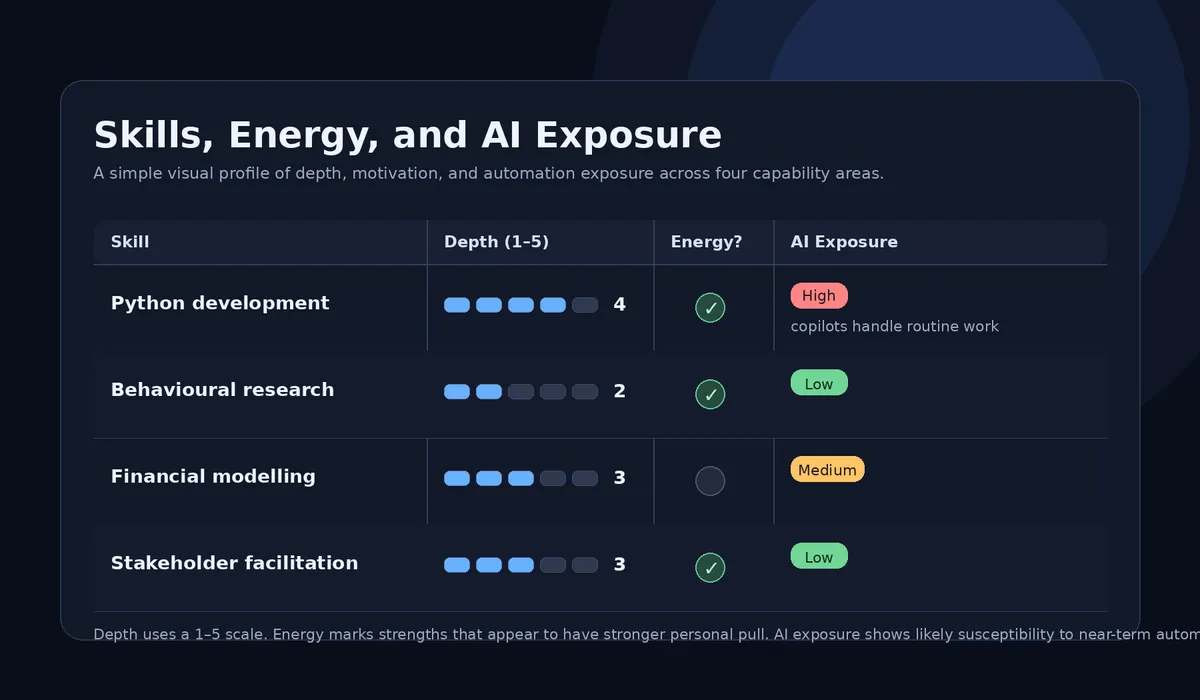
This person has the beginnings of a constellation: a strong technical point, an emerging behavioural-science point that draws genuine curiosity, and a facilitation skill AI barely touches. The financial modelling sits at a useful 3 but draws no energy or cursiosity — probably not a constellation point.
Most people will find a similar pattern. Their highest-rated skills cluster in one or two areas (their current T or Pi shape), while a long tail of 2s and 3s stretches across many domains. That long tail is more valuable than they think — it is where meta-learning ability already lives.
2. Choose Two or Three Points Deliberately
Select the disciplines you want to strengthen. Use four filters:
- Orthogonality: are they meaningfully different?
- Energy: do they sustain real curiosity?
- Leverage: does AI amplify your value in the area? or do these skills, set outside the realms of where AI plays a meaningful role (e.g. Quantum Computing, health and well being, new materials science)?
- Synthesis potential: can you already see useful intersections?
Do not choose points only because they feel prestigious or adjacent to your current role. Choose them because, together, they form a more powerful pattern.
3. Strengthen the Core Relentlessly
Your three meta-skills need deliberate investment. They are force multipliers — they make every other point in the constellation more valuable.
Meta-Learning:
- Study the science of learning itself. Ultralearning by Scott Young and Make It Stick by Brown, Roediger, and McDaniel are excellent starting points.
- Practice the Feynman Technique: explain concepts in simple terms to test your understanding.
- Build a personal knowledge system. Capture what you learn, connect it to what you already know, and revisit it regularly.
- Learn what works for you - the above books and methods may not work for all - find your path.
Systems Thinking:
- Try reading Thinking in Systems by Donella Meadows — it is the foundational text, or find other ways to learn systems thinking.
- Study architecture patterns in your domain and adjacent ones. How are complex systems designed to handle complexity?
- Practice drawing system maps of things you encounter: organisations, products, markets, arguments.
Judgement / Taste:
- Expose yourself relentlessly to excellence. Study the best work in your disciplines and beyond.
- Study and learn from people whose judgment you admire — and seek to understand their decision-making.
- Practice making predictions, and testing those predictions in real world context. Give yourself many swings at the ball. For example - in product building - how can you increase the number of products you can ideate and test with customers, to understand and develop taste on what lands for the customer segment that matters.
4. Practice Synthesis on Purpose
Do not wait for synthesis to happen accidentally. Train it.
Pick two constellation points and create something that genuinely requires both. Not one as a side note to the other, but both as load-bearing elements.
Say your points are behavioural psychology and software architecture. Do not just read about both — design an onboarding system where the technical architecture embeds behavioural principles: progressive disclosure, variable reward schedules, friction reduction at decision points. Prove that the sum of the whole is greater than the individual parts, by creating value that can be measured. The architecture concepts and the psychology concepts become inseparable, once things work. This is synthesis under real constraints.
Or combine financial modelling and design: build a visual scenario-planning tool where the interface choices are driven by how people actually process uncertainty — not just how the numbers are structured.
The point is to strengthen the habit of connecting disciplines, where it drives real world value, under real constraints. There are opportunities everywhere we look around the world - we just haven't had the bandwidth or the tools to chase them.
Learning also should be hard. Going deep in a domain (whether academic papers, running experiments, failing at achieving goals) requires sacrifice and resilience. If it’s too easy and things are going too well - stop and check whether your really going deep enough. Deep learning most often comes from the failures on the way to success. If we are not failing - it’s possible we are not going hard enough to build our constellation.
5. Reconfigure Over Time
Your constellation is not permanent.
At least once a year, step back and ask:
- Which point is becoming commoditised?
- Which area is pulling my curiosity?
- Which combinations still generate insight?
- Where has my identity frozen around an old version of my value?
- Where is the market changing, and where are my skills more / less in demand?
Do not cling to a point just because it once defined you.
A developer point on a constellation might evolve from writing code to designing AI-human delivery systems. A strategy point on a constellation might evolve into product architecture. An industry domain point might fade while a new one emerges.
The core can stay stable while the outer pattern changes.
Your constellation will be unique to you, and to the environment or markets you work in. Financial Services will always value deep history and understanding of financial markets, as will Quantum science value deep physics and mathematical skills. But the ability to synthesise domains and bring new insights, powered by the AI tooling around you, is where value will be created.
What This Means for Your Career
A few implications follow.
Stop Optimising for Depth Alone
Going from a 4 to a 5 in a narrow implementation skill may still matter in some contexts. Hard science, frontier work, will all need deep experts in a field. But in many AI-enabled environments, the bigger gain may come from adding a new point, deepening a synthesis line, or improving your judgment.
Choose Roles That Reward Integration
The most valuable roles will often sit at intersections: product with technical and commercial fluency, strategy with delivery and systems understanding, leadership with cross-functional pattern recognition.
Look for roles where synthesis is at the heard of the role, not at the periphery.
Invest in Your Pattern, Not Just Your Resume
Your competitive advantage is less likely to be a single skill and more likely to be a specific combination that is difficult to replicate. Two people may share one point. Few will share the same whole constellation.
That is what makes the model useful. It gives you a way to think about career differentiation that is more realistic than simply stacking more credentials in the same lane.
The Bottom Line
The T-shaped model was built for a world where human implementation skill was the main bottleneck.
That is no longer the whole story.
In the AI era, value shifts upward toward:
- How quickly you can learn (meta-learning)
- How clearly you can see systems (systems thinking)
- How reliably you can judge quality — and how well you understand what people actually value (taste)
- How creatively you can combine disciplines (synthesis)
How well you combine all of these will shape how you create real-world value for others.
Depth still matters. Execution still matters. But the people who stand out will increasingly be the ones who can frame, connect, evaluate, and synthesise.
Stop trying to be a T. Start building your constellation.
What does your constellation look like? I’d love to hear what combination of disciplines you are building around. Find me on LinkedIn or X.