Play or vanish: how AI is changing how brands win (or lose)
For the last 20 years, enterprise brand and distribution strategy has been fairly stable. We built a narrative, wrapped it in guidelines, and pushed it out through owned, earned and paid channels: websites, email, PR, search, social, then TikTok and YouTube. Everything on brand and on message.
That game isn’t going away, but a new one has begun.
OpenAI now reports that ChatGPT reaches around 800m weekly active users. It’s moving beyond “chatbot” into shopping, payments and apps that transact directly inside the conversation. OpenAI is also rolling out Sora as a TikTok‑style social app for AI‑generated video, where people can remix themselves, their friends – and, over time, brand assets – into short, viral clips. If you have been following the broader shifts covered in this blog to date, you might have already started to see the outlines of this in our earlier thinking on how AI will reshape organisations and jobs.
Consumer attention is moving fast. How we browse, learn and procure is changing rapidly as the internet goes through its next major transformative shift.
For CMOs and C-suite leaders, this isn’t a sideshow. It’s quickly becoming a new distribution layer for our brands.
1. From Channels to Engines: Discovery Has Moved Again
The last big shift was from print and broadcast to search and social. We optimised for:
- Search: SEO, landing pages, content hubs.
- Social: TikTok, YouTube, LinkedIn, Instagram, paid and organic.
- Owned: blogs, newsletters, gated assets.
LLMs add a new front door: AI engines.
When a customer types:
“Who are the best providers for X in Y market?”
that query is increasingly going to ChatGPT, Gemini, Perplexity and others, not just Google. Those engines are starting to:
- Answer questions directly instead of listing links.
- Show richer product and pricing details inside the answer.
- Trigger actions (book, buy, subscribe, connect to an app) without the user ever seeing the recommended homepage.
For the enterprise, that means:
Our brands don’t just have websites and social channels anymore. They have machine‑interpreted profiles inside each AI engine.
If we don’t actively shape that profile, we’ll lose share of voice to those who do.
So how big is this trend? Nothing to panic about just yet. Right now, AI engines still send only a sliver of overall traffic – approaching 1% of visits (~1.1bn referral visits in large mid‑2025 cross‑site studies) – compared with Google’s overwhelming share (~191bn referral visits). But that sliver is compounding fast. Multiple 2025 analyses using Similarweb and Conductor data show AI referrals growing at triple‑digit rates year‑on‑year, with ChatGPT responsible for the vast majority of that volume. In some large ecommerce datasets, traffic referred by ChatGPT is already converting at roughly twice the rate of traditional organic search. As of October 2025, ChatGPT.com is the 5th most visited website on the web.
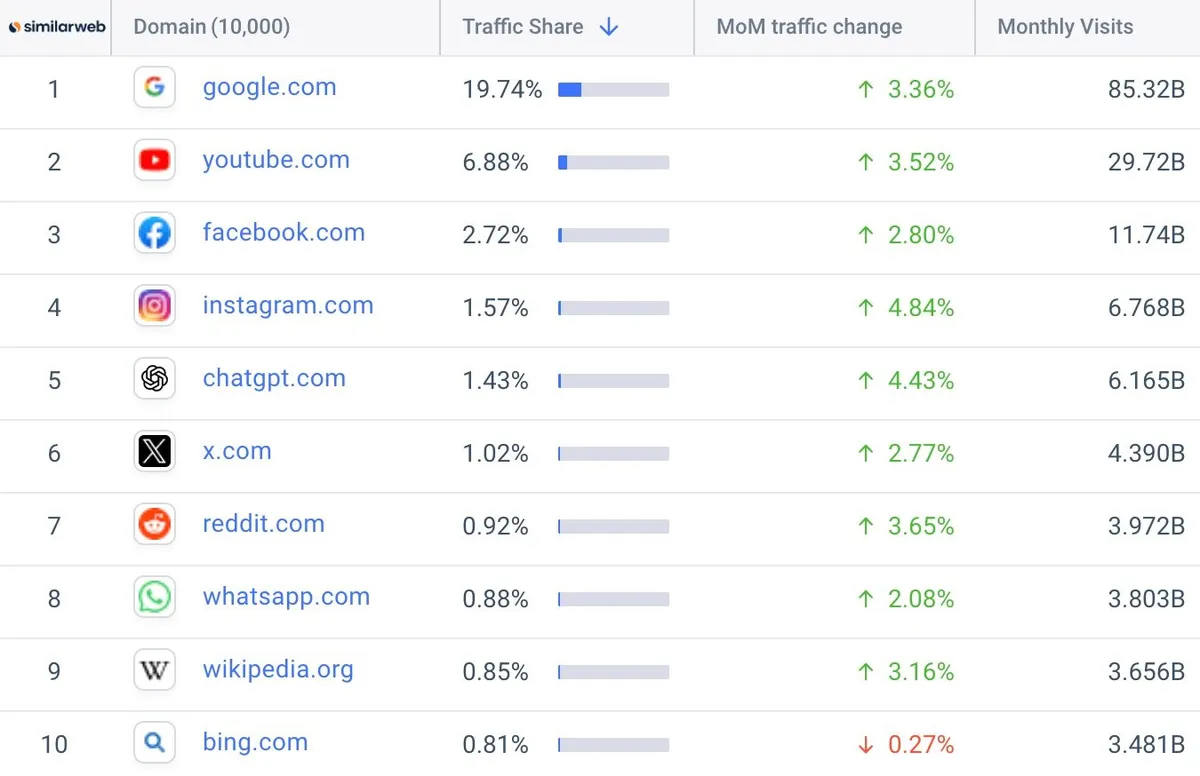 SimilarWeb, October 2025
So, while absolute numbers are still small, the trend is there. If this curve continues, the “AI front door” could move from rounding error to material share of acquisition in just a couple of planning cycles. The brands that are easy for engines to understand today will be the ones those engines reach for by default tomorrow.
2. From SEO to AEO: Competing for AI Engines
With this in mind, SEO isn’t dead; it’s just no longer the whole game.
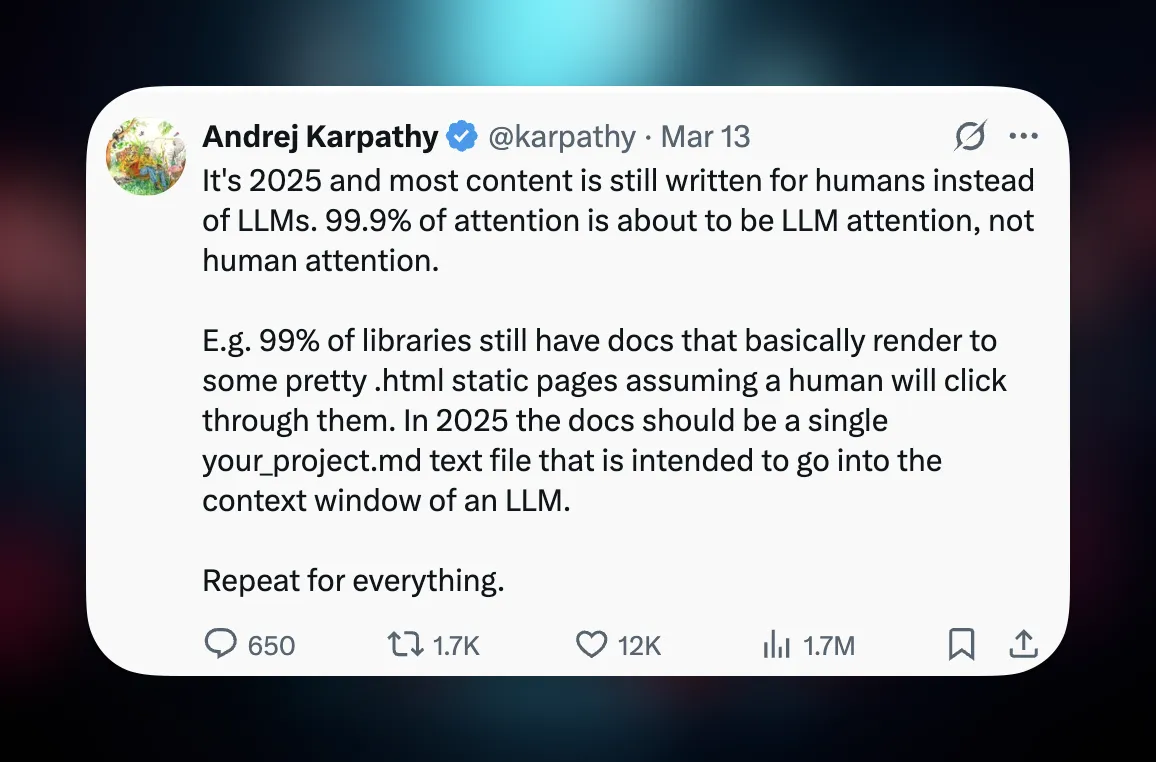
A growing chunk of discovery is moving into AI Engine Optimisation (AEO) – structuring our brands so that AI assistants can:
- Understand who we are and what we do.
- Trust us as a credible source.
- Use our information to answer a user’s question.
- Act on our behalf (book, buy, refer) when it’s the right fit.
If we’ve read or written about the emerging discipline of AEO before, this will feel familiar – but here we’re taking it from theory to practice.
In practice, that looks like:
- Clear, machine‑readable entities: company, products, services, industries, geographies, proof points.
- Canonical answers to the top 50‑100 questions our buyers actually ask.
- Structured content (schema, FAQs, Q&A blocks, specs, pricing ranges, implementation details).
- Consistency across our sites, documentation, case studies, app listings and public data sources.
We’re not abandoning SEO – we’re extending it. Think of AEO as:
SEO for answers, not just pages.
The engines are looking for clean, unambiguous, well‑supported answers they can confidently quote, not just long‑form blog posts stuffed with keywords.
3. Designing AI‑First Websites and Content
If we assume our primary visitor is an AI model rather than a human, our website looks different.
a) Start from questions, not pages
Most enterprise sites are structured around internal org charts: “About”, “Products”, “Solutions”, “Resources”. AI engines don’t care. They care about:
- "What problem do you solve and for whom?"
- "How do you compare to alternatives?"
- "What does implementation look like?"
- "What risks are involved and how are they mitigated?"
- "What proof is there that it works?"
We can refactor our content so those questions have:
- One canonical answer page each.
- A short, direct answer high on the page.
- Supporting detail, diagrams, and evidence structured below.
b) Make content machine‑legible
No-regret moves could include:
- Using structured data (schema.org, product and FAQ markup) wherever possible.
- Keeping names, numbers and claims consistent across our sites, PDFs, slide decks, app stores and partner listings.
- Publishing technical and risk documentation (security posture, compliance, SLAs) in ways that are easily parsed and cited.
- Maintaining a living “What we actually do” page that’s brutally clear and regularly updated.
- Consider adding an /llms.txt (and/or similar AI manifest file) at our domain root. These proposed / emerging standards act like an AI‑specific sitemap, giving LLMs a curated map of our best documentation, product pages, FAQs and legal/compliance content so they don’t have to guess where the good material lives.
- Making sure our robots.txt and any ai.txt rules are intentional for reputable AI crawlers: what’s allowed for retrieval, what’s off‑limits for training, and what must always carry attribution. Even if support is uneven today, getting our position onto the record is low‑cost and future‑proofing.
- Where it makes sense, linking prominently to credible third‑party coverage (analyst reports, customer reviews, regulatory registers, independent case studies) so engines always see our claims in the context of external evidence, not just our own marketing copy.
c) Expose an action surface
LLMs are moving from answering to doing.
If we want AI engines to route customers to us, we should make it easy for them to:
- Start a trial or demo.
- Generate a pre‑filled RFP response template.
- Book time with sales or support.
- Trigger key workflows via APIs.
We don’t necessarily need a new platform. We do need one or two simple, well‑documented ways for an assistant to act on the user’s intent with us instead of a competitor, or to use standard UI patterns so that a machine can navigate the website on a user's behalf, if directed.
For more context on building agentic systems within the enterprise, see Beyond the Hype: Building Agentic Systems for the Enterprise.
4. Sora, Synthetic Social, and Brands as "Playable Characters"
Sora potentially shifts the game again.
Instead of posting a video about our brand, people can now generate videos with our brand – a mascot, a product, even an executive likeness – dropped into their own stories.
If we work in brand or legal, this could sound terrifying. However, it's a potential major commercial opportunity.
Because in a Sora‑style world:
- Our brands can become “playable characters” people actively choose to feature.
- We can distribute official, rights‑managed avatars (characters, product renders, environments) for people to use inside their own content.
- Platforms are starting to explore monetisation and control tools so rightsholders can set rules and share in upside when their assets are used.
The strategic question isn’t “How do we stop this?” – we probably can’t.
The question is:
Do we want to be part of the story people are telling with AI video, or do we let everyone else define us in absentia?
Sit out vs. lean in
If we sit out Sora and similar environments:
- We preserve tight control on paper, but
- We risk becoming invisible in a channel our next generation of customers lives in.
If we lean in with guardrails:
- We accept we won’t script every frame, but
- We gain massively leveraged reach, earned creativity and, over time, new monetisation paths.
That’s the trade‑off. Access vs control. For many enterprises, the right answer may be managed participation – not ban, not free‑for‑all. But it will depend on the industry, size of the opportunity, level of risk, regulatory standards, and degree of competition.
5. A Heterogeneous, Multi‑Channel World
Up until now, a small number of channels (mostly on Google's ecosystem or Meta's) have dominated enterprise brand and marketing spend. However, there are more options coming online.
We’ll have, in parallel:
- Google: traditional search + AI Overviews + Gemini.
- OpenAI: ChatGPT for answers, shopping and apps; Sora for social video.
- Meta, TikTok and others: still powerful for community and culture.
- Vertical engines and industry channels: industry‑specific platforms in finance, health, government, etc.For example, mortgage broking platforms in financial services, consisting of new and existing players
As each channel comes with slightly different rules and levers, what we need is a coherent base layer:
- A single, up‑to‑date source of truth for what we do.
- Clear, structured representations of that truth everywhere we show up.
- A simple internal rule: “If we change it here, we change it in all the places models are likely to read it.”
In plain language: this “coherent base layer” is just a single, consistent set of facts and short narratives about our company that everything else is built from. We agree it once, keep it up to date, and then reuse it everywhere instead of reinventing it channel by channel.
On top of that, we can then tailor:
- Formats for TikTok, YouTube, LinkedIn, Sora.
- Depth and proof for Gemini vs ChatGPT.
- Risk/compliance posture for regulated vs unregulated channels.
But without the base layer, we’re running a multi‑player game with no playbook.
6. Trust, Advocacy, and External Signals
One of the under‑appreciated changes in the AI era is the renewed importance of third‑party voices.
AI engines increasingly:
- Pull from multiple sources to answer a query.
- Prefer authoritative, independent commentary over self‑descriptions.
- Surface citations and links back to those sources.
So our brand narrative is no longer just what we say about ourselves. It’s what:
- Analysts, partners and customers publish online (including social media).
- Our own senior leaders write or say on the record.
- Specialist media and newsletters document.
Practically, that means brand and comms leaders should:
- Treat expert advocates (internal and external) as a core part of distribution.
- Equip them with accurate, specific, non‑hyped narratives they can stand behind.
- Encourage formats that are AI‑friendly: clear headlines, direct answers, structured arguments, open access.
We’re optimising the network of credible voices around us, not just our own homepage.
7. Implications for the C-Suite
For CMOs and the C-Suite - we need to consider both defense and opportunity. In a do-nothing scenario, brand attention continues to move to these new channels, creating risks for brand equity. The opportunistic side of these new channels is not yet a proven path, and the rules are changing swiftly in line with the underlying technology and product plays.
a) Recognise this as a new distribution game, not a side project
The shift from SEO‑only to SEO + AEO + synthetic social appears to be as big as the original move from print to digital. The difference is:
- The dollar investment to get started is small.
- The strategic upside – new share of voice, new paths to market, new data – is large.
b) Accept that early movers could earn outsized benefits
Right now, AI engines are still forming their mental models of each category:
- Who the credible players are.
- Which brands have clear, structured answers.
- Whose content consistently helps users.
If we move early:
- We become one of the default examples the models reach for.
- We build history and trust signals that are hard for latecomers to match.
c) Govern the risk, don’t hide from it
Board‑level questions should be:
- What’s our risk appetite around synthetic content and third‑party remixes?
- What’s our policy on official avatars, spokespeople and IP in AI video?
- How do we ensure regulatory and brand safety while still competing for attention?
Those are tractable questions. We can build policies, guardrails and monitoring around them. What we can’t do is wish the new environment away.
8. A Practical Early‑Mover Playbook
If you're a brand or marketing leader wondering where to start, here’s a simple starting point:
Run an AI visibility audit
Ask ChatGPT, Gemini and others what they say about our category and who they recommend. Record the results. This is our new “AI share of voice” baseline.Stand up a small AEO squad
Bring together SEO, content, engineering, data and legal. Give them a 90‑day mandate: make the brand machine‑legible and AI‑friendly. Identify key metrics, and demonstrate practical, measurable results. The same squad can then lead three early workstreams:Define 50 “AI‑ready answers”
For the top questions our customers actually ask, we can write short, direct, well‑evidenced answers and publish them on canonical pages. Continue to measure and show results in metrics and data.Streamline existing data for AI
Clean up inconsistent product names, pricing, feature lists, and claims across our sites, docs, slide decks and app stores. Models are brutally sensitive to messy data.Run small, contained experiments in new surfaces
Try one or two flows in ChatGPT commerce. Test a limited, brand‑safe avatar in Sora (once available in Australia). Measure impact, sentiment and risk. For more depth on how agentic systems underpin these experiments, see our article Beyond the Hype: Building Agentic Systems for the Enterprise.
Report back in language the board cares about
Show how these moves impact pipeline, share of voice, cost of acquisition and brand metrics – not just clicks and views.
Closing Thoughts: Don’t Wait for the Rules to Be Final
The honest take is that none of this is fully settled. The ad models will evolve. The Sora‑style social norms will take time. The AEO playbooks will mature.
But that uncertainty is exactly why there’s opportunity.
If we wait for everything to be clean and familiar, we’ll be the brands paying premium rates to catch up. If we move early, thoughtfully and with clear guardrails, we can earn a disproportionate share of attention while the cost of entry is still low.
We’ve done this before with search, with social, with mobile. The pattern is the same.
In the AI era, brands that become easy for machines to understand – while also safe and easy for people to have fun and play with – could be the ones that win distribution.
Sources
- Similarweb & TechCrunch, AI referrals to top websites were up 357% year‑over‑year in June 2025, reaching 1.13 B, July 2025.
- Conductor, 2026 AEO/GEO Benchmarks Report, Nov 2025.
- Similarweb, Global State of Ecommerce 2025 / 3rd Annual Global Ecommerce Report, Sept 2025.
- OpenAI, Sora 2 is here, Sept 2025. 2025.